Singapore Unpacked | Episode 10 — Singapore’s National Identity: Ancient Civilisations and Modern Trends
January 16, 2026
What does it mean be Singaporean? In a recent study conducted by IPS and CNA, many identified Singlish, multiculturalism and iconic national symbols such as the Merlion and local hawker fare to be what they associate closely with Singapore’s national identity. It prompts the question, how did we arrive at this national identity, and how will it evolve as the world around us changes?
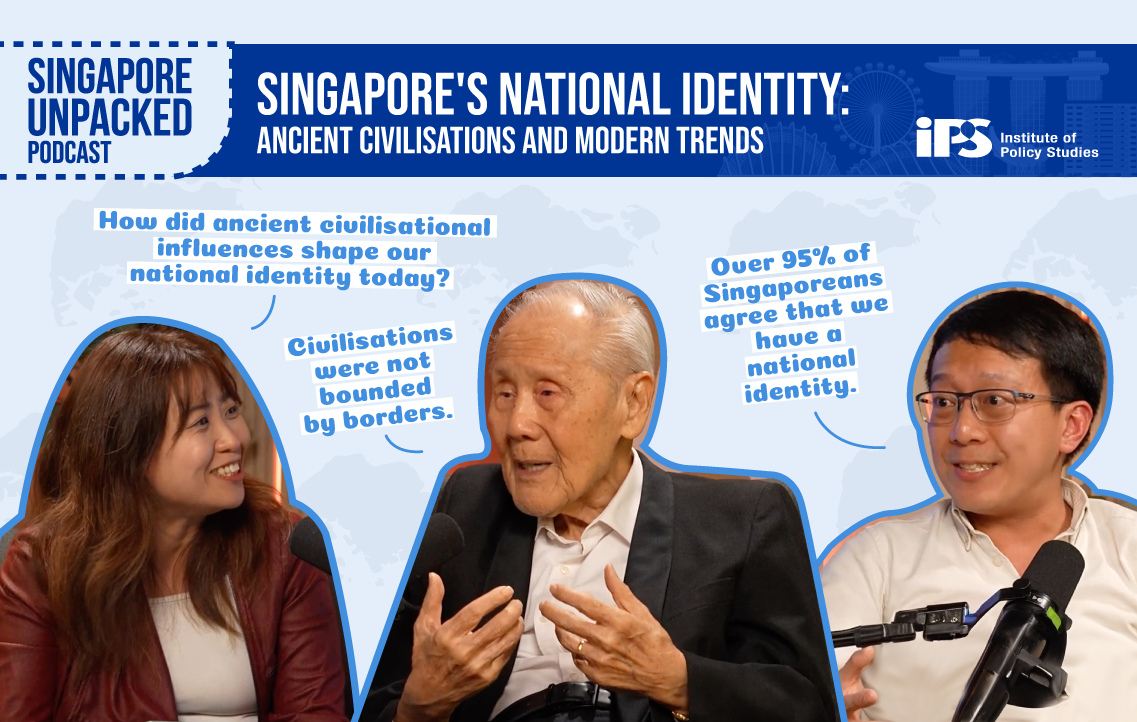
In the tenth episode of Singapore Unpacked, Host Liang Kaixin sits with Professor Wang Gungwu, University Professor at NUS and IPS’ 12th S R Nathan Fellow, and Melvin Tay, Research Fellow at IPS Social Lab, toexamine a question that is both ancient and contemporary: how have great civilisations — Indic, Sinic, and Islamic — shaped Singapore’s identity today, and how do these civilisational influences sit alongside the modern Singapore state?
Prof Wang took a long view of the history of Singapore. He situates Singapore within a Southeast Asian region historically defined by waterways, trade, exchange and long-running cultural influences, arguing that civilisations are not bounded by borders but travel through ideas, meanings and ways of life. He also traces how Singapore emerged with a distinctive British imperial culture, as a modern, secular and capitalist state. The British also brought the free port model and the administrative ordering of a port city to Singapore.
Speaking on Singapore’s post-independence choices, Prof Wang emphasises that Singapore decided to be a uniquely plural society: a society that does not expect a single civilisation or culture to dominate, and that relies on the law to uphold equality across groups. He also highlights how major political decisions — including maintaining armed forces and adopting English as an official language — shaped the framework within which a national culture and identity could evolve.
To bring in perspectives from the contemporary, Melvin shares on the findings from the IPS-CNA Study on National Identity in Singapore, including survey responses showing that over 95% of respondents say Singapore has an identity, even if there is diversity in what people think that identity comprises. He discusses how “good food” and “speaking Singlish” frequently appear in open-ended responses, alongside tangible markers like the Merlion and the Singapore passport, while practices such as multiculturalism, being multi-racial and multi-religious, and meritocracy are closely linked to respondents’ sense of pride and belonging.
In closing, the guests concludes Singapore’s national identity to be a continuing work in progress. Questions on topics like immigration — including how Singaporeans view new migrants, and whether newcomers adopt Singapore’s norms, practices and values — will shape how the national identity evolves, intersecting with the modernisation of the civilisational influences that have historically shaped the nation.
About our Guests
Wang Gungwu University Professor, NUS
12th S R Nathan Fellow
Professor Wang Gungwu is best-known for his explorations of Chinese history in the long view, and for his writings on the Chinese diaspora. He has been University Professor of the National University of Singapore (NUS) since 2007, and Emeritus Professor at the Australian National University since 1988.
Professor Wang received his BA and MA from University of Malaya (UM) in Singapore, and PhD at the University of London (1957). His early teaching career was in the UM History Department at Singapore, and then at Kuala Lumpur,1957-1968, and History Chair at UM in Kuala Lumpur,1963-1968. He was appointed to the Chair of Far Eastern History at the Australian National University, 1968-1986, where he was also Director of the Research of Pacific Studies, 1975-1980. From 1986 to 1995, he was Vice-Chancellor of The University of Hong Kong. In Singapore, he was Director of the East Asian Institute (EAI) 1997-2007 and Chairman of EAI 2007-2018; Chairman of Yusuf Ishak ISEAS, 2002-2019; Chairman of Lee Kuan Yew School of Public Policy, 2005-2017.
Melvin Tay Research Fellow at IPS Social Lab
Dr Melvin Tay is Research Fellow in the Institute of Policy Studies’ Social Lab. His research interests lie at the intersection of politics and society; with a focus on societal faultlines, their significance, and their management via policy instruments and community platforms. He has scoped, managed, and contributed to several public sector-commissioned projects on race, religion, immigration, class, sexuality, age and education – key faultlines in the Singapore context.
For those who wish to delve deeper into Singapore’s national identity, visit IPScommons.sg or follow @IPSsg on Instagram and TikTok. Stay tuned for more conversations that transform research into real-world policy stories.