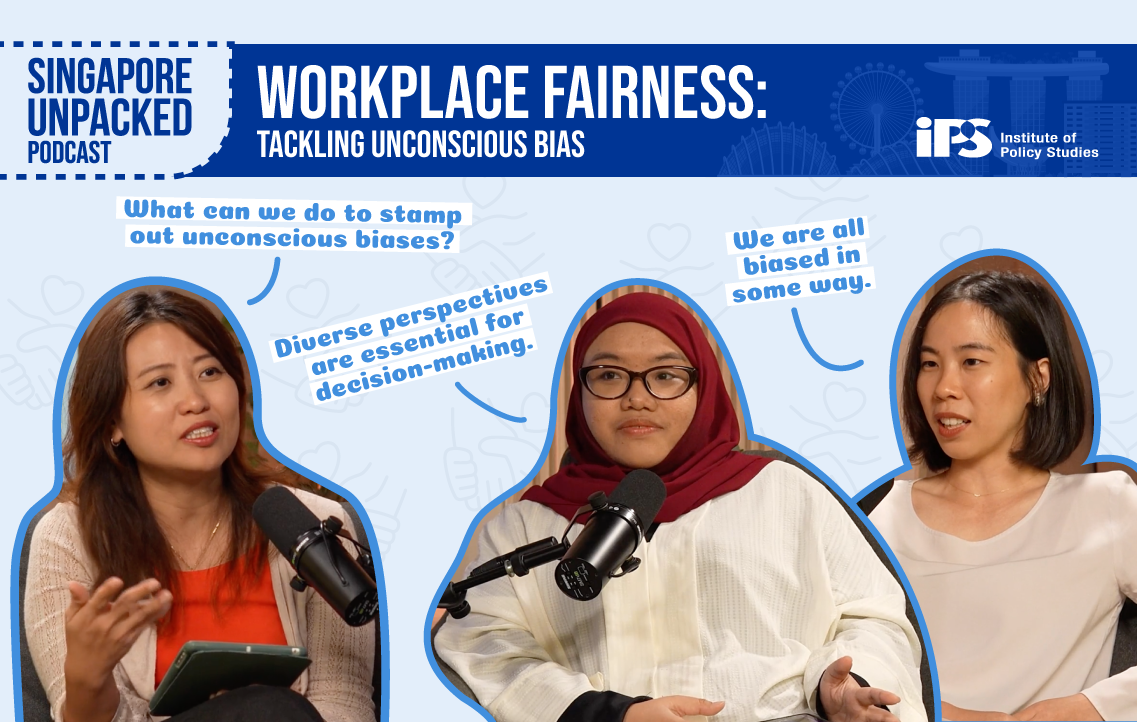
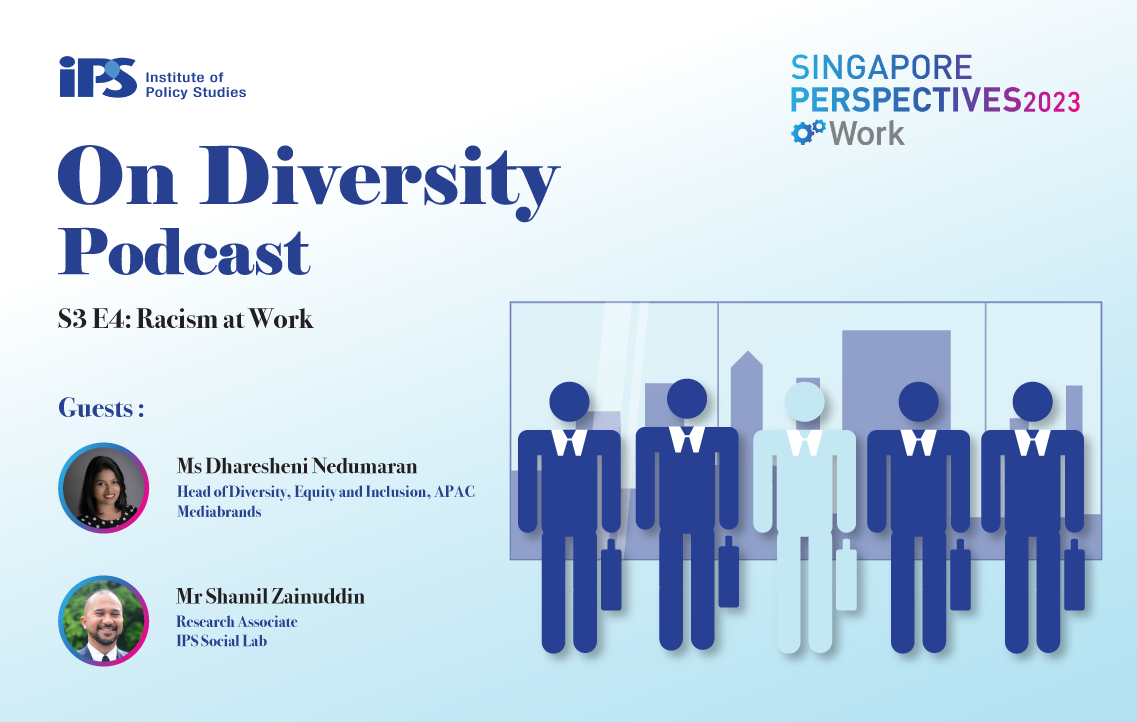
Casual racism in Singapore often emerges not from deliberate malice, but from unconscious biases embedded in everyday choices at work. In this episode of Singapore Unpacked, host Liang Kaixin is joined by IPS researcher, Sophy Tio, and Lepak Conversations founder and Director, Yulianna Frederika, to unpack how unconscious bias operates within the context of workplace life.
Drawing on Sophy’s experience running the IPS Programme on Race, Religion and Intergroup Cohesion (RRIC) and Yulianna’s work facilitating conversations on Malay/Muslim issues, they explore how acts underlined by unconscious biases can shape hiring, promotions, team culture and a sense of belonging in multi-racial, multi-religious workplaces.
The discussion surfaces how in-group and out-group biases can lead minorities to hide aspects of their identity in order to fit in, such as through anglicising their names in professional settings. The guests also discuss different approaches when faced with instances of racism in the workplaces. Although they agree on the need to correct such behaviours, they also note the need to be aware of the generally non-confrontational social norm in Asian societies. Practising allyship by checking in with colleagues, rather than placing the burden entirely on minorities to speak up is also important if its not always appropriate to speak out publicly.
Both guests emphasise the role of leadership in setting the tone, whether through modelling inclusive behaviour, addressing inappropriate comments made in public channels, or building trust so employees can safely use grievance processes linked to the Workplace Fairness legislation and the Tripartite Alliance for Fair and Progressive Employment Practices (TAFEP). At the organisational level, their discussion looks at how diversity, equity and inclusion (DEI), psychological safety and workplace fairness are often seen as burdens or “woke” agendas, and how reframing them in terms of team performance, productivity, retention and reputational risk can help organisations take them seriously.
In closing, the episode turns to technology. Both guests see artificial intelligence (AI) as a tool that can either entrench or help stamp out bias, depending on how it is trained and used. They discuss how AI can support blind hiring, analyse workforce diversity data and provide sensitivity training, including IPS RRIC’s use of AI chatbots to let participants practise intervening in difficult scenarios in a safe space. The episode ends with practical suggestions to nip unconscious biases in the workplace in the bud, from reducing tokenistic one-off celebrations in favour of meaningful, long-term inclusion efforts, to rethinking resume screening and everyday habits so that workplace fairness is reinforced not only by law, but by culture.
About our Guests
Yulianna Frederika Founder and Director of Lepak Conversations
Yulianna Frederika is the founder of Lepak Conversations, a non-profit that facilitates accessible dialogue on Malay/Muslim issues through educational content on Instagram and offline community events. It tackles pertinent social issues such as racism in workplaces and Malay men’s mental health, and seeks to build allyship between people in Singapore and Malay/Muslim communities, thereby encouraging racial harmony.
Sophy Tio Research Associate at IPS
Sophy Tio is a Research Associate at the Institute of Policy Studies. She is Lead Facilitator and Coordinator of the IPS Programme on Race, Religion and Intergroup Cohesion since its inception in 2022, and has been involved in the design and delivery of its workshops and in the studies conducted as part of the programme. To date, she has run about 70 sessions with more than 1,900 participants across various audiences. Sophy’s research interests lie in cultural diplomacy, transculturality, race and immigration, particularly the diasporic movement of Indian communities. Her current work focuses on diversity, inclusivity and equity in Singapore, investigating the landscape of racism and exploring ways to address it. She holds a Bachelor of Arts degree in South Asian Studies from the National University of Singapore, and a Master of Arts in Transcultural Studies from Heidelberg University in Germany.