

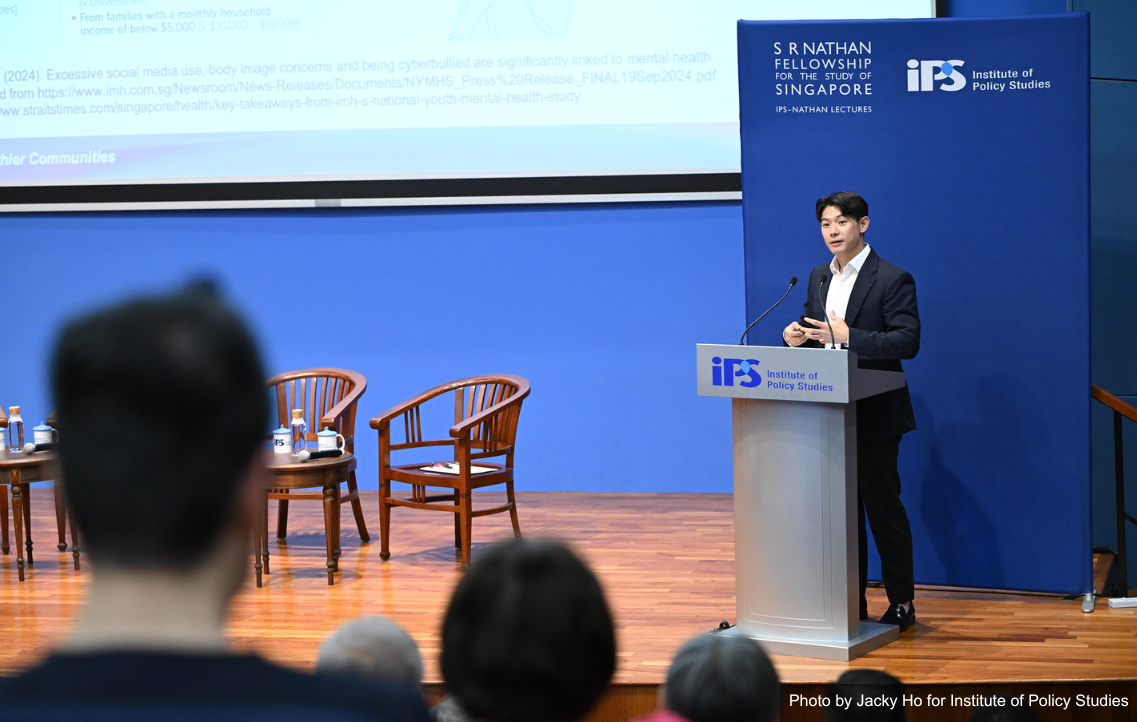
Held on the 10 February 2026, the second S R Nathan Fellowship Young Leaders Seminar, titled “Giving Voice to a Silent Epidemic: Transforming Youth Mental Health in Singapore”, featured a keynote speech by Dr Rayner Tan, Assistant Professor at Saw Swee Hock School of Public Health, National University of Singapore. Drawing on national studies and lived experiences, Dr Tan examined the structural, social and behavioural factors shaping youth distress, and called for more holistic, individualised and system-wide responses.
Lived Experience and the Sociological Insight
He emphasised that youth mental health should not be seen as just a clinical issue, but as one embedded in social context, relationships and institutions.
The State of Youth Mental Health in Singapore
Citing national studies, Dr Tan noted that close to one in three youth aged 15 to 35 report severe or extremely severe symptoms of depression, anxiety or stress, while suicide remains a leading cause of death among those aged 10 to 29. Two in three Singaporeans report at least one adverse childhood experience, which is strongly associated with later mental health challenges. The Youth Epidemiology and Resilience Study (YEAR) further showed significant levels of anxiety and affective problems among school-going adolescents.
Social Determinants, School Stress and Identity Formation
Dr Tan highlighted how socioeconomic disadvantage, unemployment and being not in education, employment or training (termed “NEET”) are linked to poorer mental health outcomes. Behavioural factors such as excessive social media use, peer victimisation and body image concerns also contribute to distress. Academic stress, particularly around high-stakes examinations, emerged as a key pressure point. When affirmation and stable support are lacking, identity may be left “in flux”, increasing vulnerability.
Rethinking Mental Healthcare
A central theme of the keynote was the need to move beyond a purely pathogenic model of mental health — one focused on diagnosis and treatment — towards a dual-continua model that recognises mental illness and mental wellness as related but distinct dimensions.
Dr Tan explained that the absence of mental illness does not necessarily equate to the presence of well-being; conversely, individuals living with mental illness may still experience high levels of purpose and meaning. Suicide, he noted, does not always arise solely from diagnosable mental disorders, but often from situational despair and social context.
Promoting mental wellness therefore requires investment not only in treatment, but also in resilience-building, positive self-image, emotional regulation and supportive environments. He added, “Mental health policy can no longer proclaim to promote the mental health of the population while investing only in treatment and the study of mental illness.”
Tailoring Care and Elevating Lived Experience
Dr Tan emphasised that interventions must be tailored to cultural and community contexts. Research from national suicide prevention efforts revealed that different groups conceptualise mental health differently, underscoring the need for flexible and context-sensitive approaches. Meaningfully including lived experience in policy design, he argued, fosters participatory policymaking and sustainability.
Panel Discussion
Following the keynote, Dr Jacqueline Lee Tilley, Assistant Professor at the National Institute of Education, and Mr Daniel Ho, Senior Clinical Psychologist at the Institute of Mental Health, joined Dr Tan for a panel discussion that was moderated by Ms Alia Abdullah, Head of Digital Media and Analytics and Digital Solutions at Majlis Ugama Islam Singapura.
Achievement Pressures and Redefining Success
In interviews with students from Institutes of Higher Learning in Singapore, many described achievement not as a choice but as a baseline expectation. “It’s not enough to live a low-lying, humble life,” one student shared; success required standing out. Over time, such pressures become internalised, with self-worth tied to productivity.
Dr Tilley argued that prevention requires redefining success to include psychological health, not merely grades or credentials. “If achievement pressures are socially produced,” she noted, “then well-being must also be socially protected.”
Trauma, Marginalisation and Listening from Where Our Youth Stand
Mr Ho approached the issue from a trauma-informed and practice-based perspective. Drawing on his work with vulnerable and marginalised youth, he cautioned against assuming that youth distress is “silent”. Rather, he suggested, youth may be expressing distress loudly — but from contexts adults may not be attuned to.
He addressed common generational tensions — such as perceptions that “everything is trauma these days” — and emphasised that language evolves alongside lived experience. Trauma, he explained, must be understood within a biopsychosocial framework and within the realities of marginalised communities.
Importantly, he highlighted the role of shared accountability. While structural change is essential, societal attitudes, everyday language and power dynamics also shape youth mental health. “The side that has a little bit more power needs to take a bit more action,” he remarked, underscoring the ethical responsibility of institutions and adults.
Question-and-Answer Session
In response to questions about structural examination pressures, the panellists emphasised that while exams may be stress points, societal meaning and expectations amplify their impact. Reforms must therefore address cultural norms, not merely policy mechanisms.
On reducing medicalisation, Dr Tan clarified that the goal is not to reject clinical care, but to avoid defining success solely by diagnostic outcomes. Empowering communities, training peer supporters and integrating lived experience into service design were identified as key pathways forward.
Click here to watch the video of the lecture.
AI Assisted Tools (ChatGPT, GPT-4o and Cockatoo v3) were used for initial transcription and drafting. All substantive analysis, interpretation, and verification were conducted by the authors, who retain full responsibility for the content.