

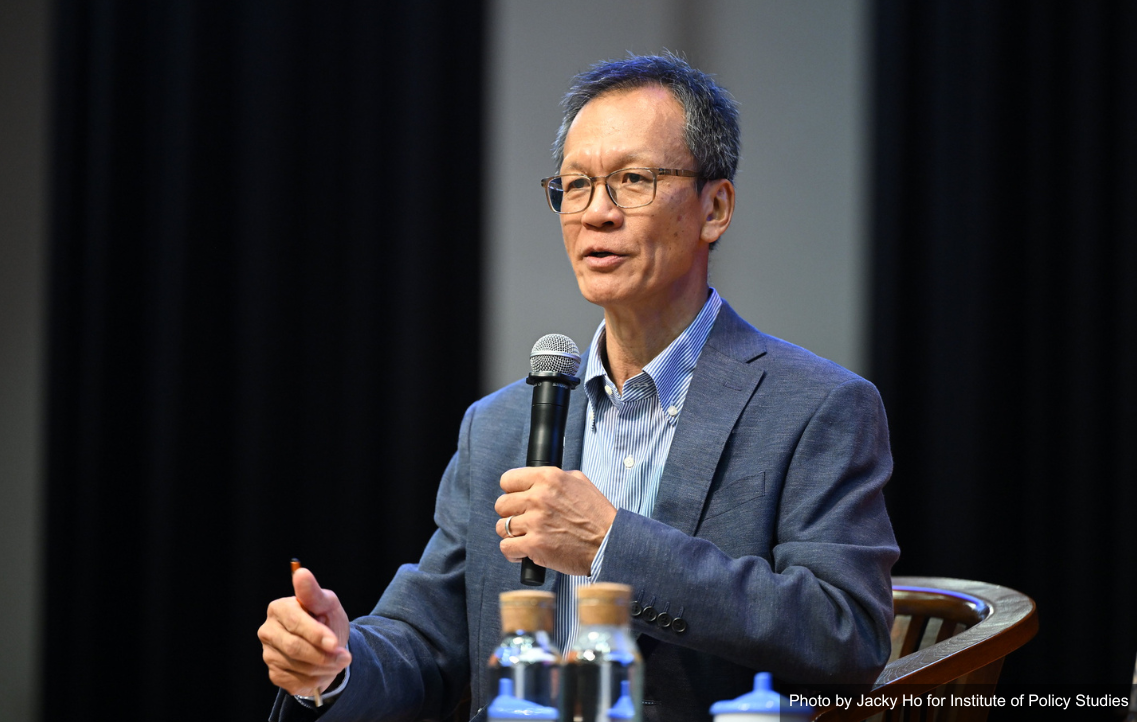
Held on 9 March 2026, the first lecture of the 18th IPS-Nathan Lecture Series, titled “Singapore, Biodiversity and a Thriving City”, was delivered by Dr Shawn Lum, Senior Lecturer at the Asian School of the Environment, Nanyang Technological University. The lecture explored Singapore’s environmental transformation, the science of biodiversity conservation, and the social attitudes that shape how people relate to nature.
Dr Lum argued that biodiversity is not merely about protecting plants and animals but about sustaining resilient societies. As he observed, “Nature is not really about just nature. It’s really about people — and thriving societies have thriving nature and vice versa.”
From Garden City to a City in Nature
Over time, the vision evolved. Singapore first reimagined itself as a “City in a Garden”, before shifting to today’s aspiration of a “City in Nature.” The distinction reflects a deeper integration of ecological systems within urban life, recognising biodiversity as central to national well-being.
Dr Lum highlighted that despite Singapore’s small size and dense development, remarkable diversity found within the island’s ecosystems — including more than 300 species of birds and butterflies and over 2,000 plant species. Even Singapore’s coastal waters harbour extraordinary biodiversity, with roughly one-third of the world’s hard coral species recorded locally.
Yet this natural wealth often goes unnoticed. Many residents, he noted, live their entire lives unaware of the biodiversity surrounding them.
The Historical Loss of Singapore’s Natural Habitats
Dr Lum then described how Singapore’s natural landscape has changed over the past two centuries. Before colonial development, the island was largely covered by tropical rainforest, freshwater swamps and mangroves, and supported a wide variety of wildlife.
Within 50 years of the establishment of the British trading colony, more than 90 per cent of Singapore’s natural habitats had already been cleared for plantation agriculture.
Today, only small fragments of these original ecosystems remain, such as Bukit Timah Nature Reserve and parts of the Central Catchment Nature Reserve. While these areas continue to support rich biodiversity, recent studies by NUS suggest that around 30 to 40 per cent of species historically recorded in Singapore may already be locally extinct. In addition, recovery of primary habitats can be extremely slow.
Nevertheless, Dr Lum noted that the remaining habitats still contain significant biodiversity and offer opportunities for conservation and restoration.
Biodiversity in an Urban Environment
The lecture also introduced key ecological concepts that are relevant to urban conservation. One was ecological succession, the natural process by which vegetation regenerates over time. In tropical environments, even open land can gradually develop into forest if left undisturbed.
Dr Lum also discussed the theory of “island biogeography”, which explains how habitat size and isolation influence species diversity. In cities, nature reserves function like ecological “islands” surrounded by urban development. Smaller and more isolated patches of habitat tend to lose species more quickly, highlighting the importance of ecological connectivity between green spaces.
Human-Wildlife Interactions in a City in Nature
As Singapore increases green spaces and restores habitats, wildlife has become more visible in urban areas. Dr Lum pointed to the return of smooth-coated otters, once rarely seen locally but now present in waterways across the island. While their return represents a conservation success, it has also led to occasional conflicts, such as otters eating ornamental fish in residential ponds. Similar tensions arise with species such as wild boars, which can pose safety risks.
Dr Lum suggested that such conflicts often reflect differences in how people perceive wildlife. For example, birds such as the Asian koel, commonly criticised in Singapore for their loud calls, are regarded as auspicious symbols in other cultures.
These contrasting perspectives highlight how cultural attitudes shape human relationships with nature.
Shifting Baselines and the Extinction of Experience
A central theme of the lecture was the concept of shifting baselines, sometimes described as the “extinction of experience”. Each generation becomes accustomed to a slightly diminished natural environment compared to the previous one.
Dr Lum illustrated this using historical and satellite images showing how forested or coastal landscapes have gradually been replaced by housing, roads and other infrastructure. Younger generations may not realise what once existed in these areas.
This gradual loss of ecological memory can make conservation more challenging, as people may lack a reference point for what has been lost.
Biophilia, Biophobia and Public Attitudes Towards Nature
Dr Lum also discussed the concept of biophilia, the idea that humans possess an innate affinity for nature due to our evolutionary history. On the opposite side of the coin, some people experience biophobia, or a strong fear of wildlife and natural environments.
Research suggests that childhood exposure to nature plays an important role in shaping attitudes towards wildlife. Even simple experiences such as gardening or playing outdoors can foster familiarity and reduce fear.
Policy and Community Actions
Dr Lum outlined several ways Singapore could further strengthen biodiversity conservation. These include improving the management of fragmented habitats, enhancing habitat restoration efforts, and strengthening monitoring of invasive species introduced through trade or horticultural activities.
He also suggested that urban landscapes could contribute more actively to biodiversity. For example, parks, gardens and even small urban spaces could be used to cultivate rare, endangered plants or support pollinators such as bees and bats.
Such efforts could help strengthen ecological connectivity across the island while bringing nature closer to everyday life.
Reconnecting Society with Nature
Despite the importance of scientific knowledge and policy interventions, Dr Lum stressed that conservation ultimately depends on how people relate to nature.
“The science can get us pretty far, but the science will not get us out of the biodiversity crisis. I think it’s a change from within [that is needed].”
He reflected on how his own childhood experiences of spending time outdoors helped cultivate a lasting appreciation for nature. Providing similar opportunities for younger generations, he argued, will be crucial for building a deeper connection between society and the natural environment.
He concluded by observing that nature offers a sense of wonder and meaning that enriches human life. As he put it, “Nature can provide that magic. A world without magic is maybe not a world worth living in.”
Question-and-Answer Session
The lecture was followed by a discussion moderated by Ms Audrey Tan, Assistant News Editor at The Straits Times.
Responding to a question about how Singapore can balance its “City in Nature” vision with rising reports of human–wildlife encounters, Dr Lum suggested that many tensions stem from unfamiliarity with wildlife. He emphasised the importance of creating opportunities for people, especially children, to encounter nature in positive and gradual ways. Urban design, education and community engagement can help cultivate appreciation rather than fear of the natural environment.
Another audience member asked whether biodiversity conservation should be driven primarily by policymakers or individuals. Dr Lum noted that while policies and urban planning are important, societal attitudes also matter. Schools can introduce environmental knowledge, but families and communities play a critical role in shaping early experiences of nature and helping people overcome fear or discomfort towards wildlife.
Participants also raised questions about how the economic value of biodiversity might be quantified. Dr Lum explained that economists sometimes estimate nature’s value through ecosystem services, such as water purification, cleaner air and the cooling effects of urban greenery. However, he suggested that such calculations capture only part of nature’s broader value to society, noting that the challenge lies in not only getting people to understand nature’s importance, but also in encouraging them to take action on it.
A further question addressed Singapore’s AI policy and the growing role of data centres, which are often energy- and water-intensive. The audience member asked how these environmental costs could be reconciled with Singapore’s sustainability ambitions, including biodiversity conservation and climate action.
In response, Dr Lum acknowledged the transformative potential of artificial intelligence but emphasised the importance of using such technologies responsibly. He noted that while AI can deliver significant benefits, its development and deployment should be guided by ethical considerations and environmental awareness. As he observed, “there still needs to be a kind of wisdom and compassion in its usage — compassion for others, compassion for the environment.”
Dr Lum also highlighted the broader challenge of balancing technological progress with sustainability. Even technologies commonly seen as environmentally friendly may carry trade-offs. For example, renewable energy infrastructure such as solar farms can require large areas of land that might otherwise support ecosystems. “It sounds like this unlimited supply of free energy, but it’s not free — it comes at cost,” he remarked.
Ultimately, he suggested that the challenge lies in ensuring that technological advances are deployed thoughtfully, with attention to long-term environmental impacts and equitable social outcomes. “These are things that we really need to use wisely, with foresight, and with care for each other, and with care for the environment.”
AI Assisted Tools (Cockatoo v3 and ChatGPT Auto) were used for initial transcription and drafting of this report. All substantive analysis, interpretation and verification were conducted by the author, who retain full responsibility for the content.
Click here to watch the video of the lecture.