

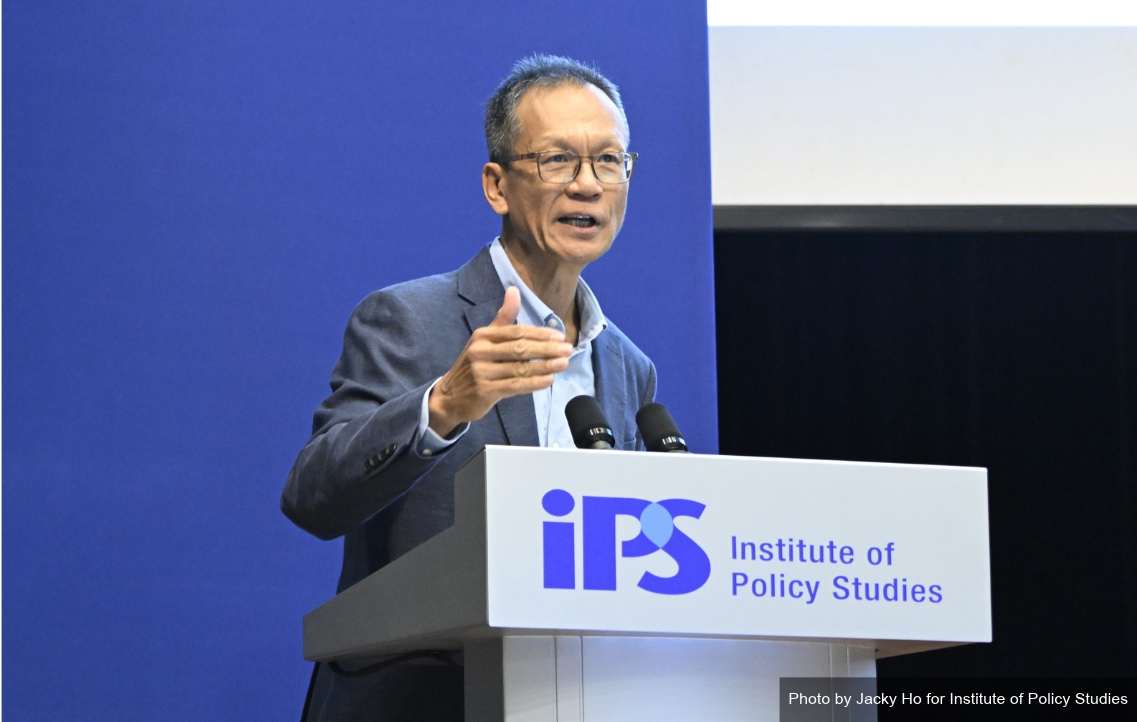
18th IPS-Nathan Lecture Series: Lecture III “Singapore, Nature and the Wider World” by Dr Shawn Lum
Dr Shawn Lum, Senior Lecturer at the Asian School of the Environment, Nanyang Technological University, delivered his third and final lecture of the 18th IPS-Nathan Lecture Series on 16 June 2026. Titled “Singapore, Nature and the Wider World”, the lecture explored how Singapore could punch above its weight in contributing towards global biological conservation.
Sovereignty, Ecological Red Lines and Tipping Points
Dr Lum acknowledged the familiar argument that a land-scarce nation like Singapore must weigh nature against the development of housing and industry. He noted that larger nations have made the same case on a far bigger scale and pointed to former Malaysian Prime Minister Dr Mahathir Mohamad as one of its biggest proponents. The contention is that developed countries cleared their own forests long ago and reaped the benefits, sometimes drawing resources from their colonies as well. On this view, nations today are only doing what others did before them, exercising the same sovereign right over their own resources.
However, Dr Lum posed a different question of where the ecological limits lie. Drawing on research into critical transitions in the Amazon, he explained that ecosystems such as rainforests and savannahs are each resilient, but that beyond certain thresholds one can flip irreversibly into the other. He argued that science should identify these “ecological red lines” so societies can steer clear of them, ideally together.
Looking Outward and Singapore’s Capacity of Contribute
Singapore’s contribution, Dr Lum argued, cannot just be inward-looking. Maintaining our own nature reserves is vital, but not enough. He likened this to tending to one’s household while neglecting the neighbourhood, “it’s a lost opportunity, and it’s too important to ignore.”
He highlighted several sectors with outsized potential influence, including science and technology, education, banking and finance, urban planning, communications, and interfaith and cross-community initiatives. For example, he pointed to researchers based at Singapore’s universities who are already shaping global efforts, such as Professor Winston Chow who co-chaired the Intergovernmental Panel on Climate Change’s (IPCC) Working Group II in July 2023 and Associate Professor Janice Lee who is one of the lead authors for Working Group II (Impacts, Adaptation and Vulnerability) of the IPCC Seventh Assessment Report (AR7).
Conscious Consumption and Ecotourism
At an individual level, Dr Lum suggested that Singaporeans could make a difference through more conscious consumption. He noted that Singaporeans are among the world’s biggest spenders on overseas travel, spending more than SGD$3,000 per trip. By actively supporting ecotourism and conservation-linked livelihoods, travellers can help channel these dollars towards positive outcomes.
He pointed to examples such as the Bunaken dive resort in Sulawesi, which funds local water infrastructure, schools and scholarships; schemes that turn hornbill poachers into guardians, reinforcing that the birds are “more valuable alive”; and conservation-linked products such as Burung chocolate and Cambodian Crane Rice. Directed wisely, he argued, such “hard-earned tourism dollars” could deliver benefits across the region.
Diplomacy and Global Stewardship
Dr Lum highlighted Singapore’s diplomatic record, reflecting on the 1992 UN Conference on Environment and Development in Rio, chaired by Professor Tommy Koh. The conference’s declaration affirmed “the integral and interdependent nature of Earth, our home” and set out principles addressing issues such as poverty, inclusion and environmental protection. “This is 34 years ago, and it could be written today and it would still ring true,” he said. He also cited the recently concluded Agreement on Marine Biological Diversity of Areas beyond National Jurisdiction (BBNJ Agreement), the first treaty on conservation in international waters, brokered by Singaporean diplomat Rena Lee.
ASEAN and Regional Cooperation
ASEAN, Dr Lum acknowledged, lacks the binding directives of the European Union. Nevertheless, it offers a platform for shared action. Species and habitats that cross borders — migratory birds, marine turtles, dugongs and the shared rainforests of the Sunda region — offer natural grounds for cooperation. He urged that the region be managed as an ecological whole, with fair cost-sharing: “If we gain from this, we all gain together.”
Resilience, Reciprocity and Wonder
Dr Lum closed on hope, pointing to evidence that global mangrove cover has expanded since the 1980s — an “unexpected expansion” that shows “nature is resilient if you give it half a chance to come back.” He drew on the Hawaiian concept of kuleana — stewardship grounded in reciprocity, in which what we care for “will also give back to us.”
A “reimagined” relationship with nature, Dr Lum argued, must be guided by science but not dictated by it alone: “We need to be guided by science, but the solutions cannot be determined solely by science.” He emphasised that solutions must be holistic and rooted in a genuine relationship with the natural world — “without which, where will we have the empathy, and the commitment, and the resilience” to see the work through. Above all, he urged the audience not to lose sight of “the magic of the natural world.”
Question-and-Answer Session
The lecture was followed by a discussion moderated by Dr Geh Min, past president of Nature Society Singapore.
On net zero, Dr Lum doubted that the 2050 target was feasible within Singapore’s borders, given its lack of a hinterland — “it’s a city without a countryside to support it” — but pointed to a regional renewable energy grid, new nuclear options, energy efficiency and responsible carbon credits as a combined path forward.
On funding from extractive industries and drawing on his experience at the Nature Society, he described a “green, amber, red” approach: some sources clearly acceptable, some off-limits, and many requiring case-by-case judgement, often with the aim of working with such partners to make them greener.
On the paradox of efficiency, Dr Lum cited a commentary on how societies become “victims of efficiency” but noted that once people are aware of the costs, “the overwhelming majority would be prepared to pay a little bit more if that meant that the animal suffered a lot less.”
On indigenous knowledge, Dr Lum suggested that the knowledge Singapore has lost can be regained by learning from other cultures and First Nations peoples, and by giving urban children real chances to experience nature. Dr Geh Min added: “We should not have a postcolonial hangup on this… we have a lot to learn from indigenous people.”
On the impending El Nino, Dr Lum distinguished immediate responses to fire and haze — monitoring, firefighting and health measures — from longer-term resilience built through peat-swamp and ecosystem restoration, drawing on regional expertise and cross-border cooperation.
AI Assisted Tools (Cockatoo v4 Thinking and Claude Opus 4.8) were used for the initial transcription and drafting of this report. All substantive analysis, interpretation and verification were conducted by the author, who retains full responsibility for the content.
Click here to watch the video of the lecture.