

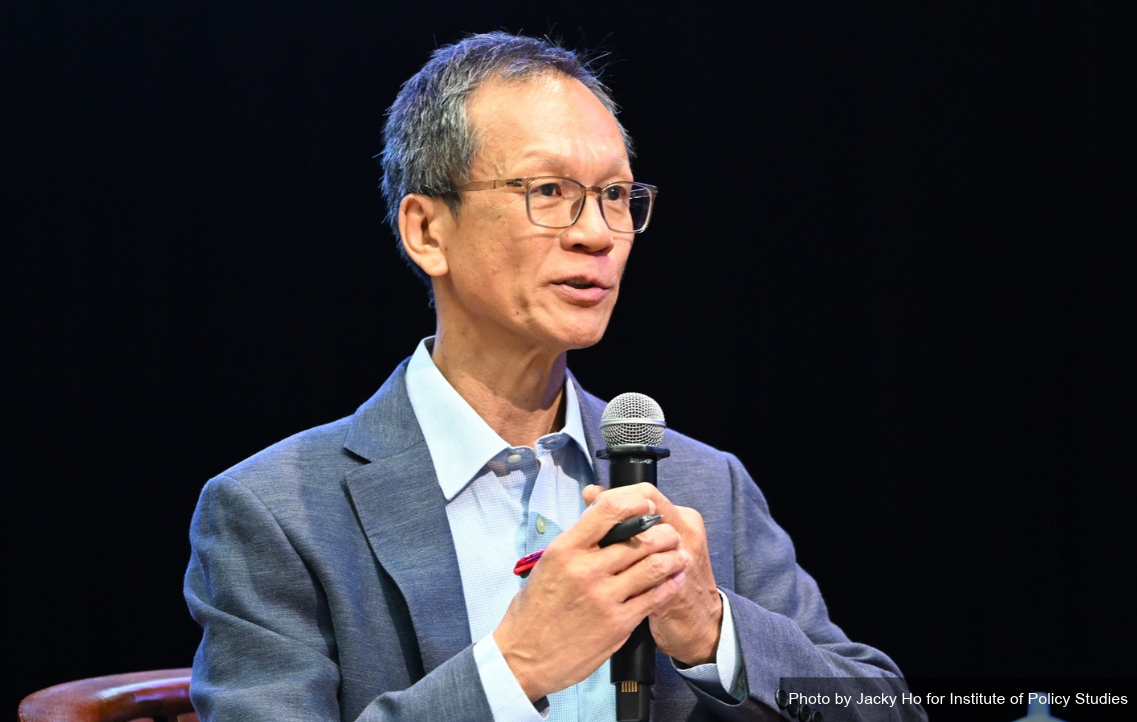
Held on 29 May 2026, the second lecture of the 18th IPS-Nathan Lecture Series, titled “Singapore, Nature and Singaporeans” was delivered by Dr Shawn Lum, Senior Lecturer at the Asian School of the Environment, Nanyang Technological University (NTU). The second lecture built on the first by shifting the question of how we conserve nature to why we should.
Existing Frameworks and its Limitations
Dr Lum highlighted the main approaches that conservationists have used to justify the protection of nature, but argued that none has yet proved sufficient to reverse the decline.
These approaches include monetary valuation, he added, where economists like NTU Professor Euston Quah take a dollar value approach in estimating the economic benefits of nature. Dr Lum also introduced a once widely used approach of pharmaceutical value, where plants and marine organisms may hold undiscovered medical cures. However, this approach has weakened as a standalone argument because once a natural compound is synthesised, the habitat that produced it need not be protected.
The current “gold standard” of valuing nature has been the use of ecosystem services as a means of categorising nature’s benefits into regulating services (such as climate regulation and carbon storage); provisioning services (food, timber, medicines); supporting services (pollination, nutrient cycling); and cultural services (recreation, wellness, ecotourism). Dr Lum acknowledged this framework is widely cited in conservation and policy circles. He also noted, however, that attempts to monetise some of these services — such as carbon credits — have run into serious problems of verification and accountability.
His conclusion was frank: “Despite all the value of ecosystem services, none of this so far has actually halted the decline in biodiversity or the degradation of ecosystems. Nature is still in worse shape every year than it was the year before.”
Nature as a Force for Social Good
Where existing frameworks have largely sought to justify nature through economic returns, Dr Lum argued that its value is perhaps better understood through a different lens altogether — one of social cohesion, public health and shared humanity.
He illustrated this with two examples. The first was ornithologist Professor Sarath Kotagama of Colombo University, who used birdwatching camps in the Sri Lankan rainforest to bring together Sinhalese and Tamil youth following the civil war. The second was Dr Goh Wei Leong, founder of HealthServe, who sought out recordings of birdsong from Bangladesh to play for isolated migrant workers during the COVID-19 pandemic as a way of restoring a sense of connection and calm.
Dr Lum also spoke on Singapore’s One Health framework, a multi-agency approach introduced in 2012 to safeguard human, animal, environmental health and food safety. This framework suggests that human, animal and ecosystem health are fundamentally inseparable. The collapse of vulture populations in South Asia, caused by the use of a veterinary anti-inflammatory drug, led to surging feral dog populations and a rise in rabies cases, illustrating how biodiversity loss carries direct human costs.
Climate Anxiety and the Urgency of Reconnection
Drawing on a global survey done in 2021 on climate anxiety in children and young people, Dr Lum highlighted how this was widespread and a serious concern among youth. The survey found that a majority reported worry, sadness, helplessness and anxiety, with nearly 40 per cent hesitant to have children.
A 2021 survey of NUS undergraduates, published in 2025, offered a more measured counterpoint: while climate change and environmental degradation topped respondents’ list of risks, many also felt that these were problems that humanity had the capacity to address. “They’re worried about it, but they also feel like we can do something about it,” Dr Lum noted. He suggested this represented an opportunity: visible, serious action on nature and climate could shift youth pessimism towards agency and optimism.
Nature, Law and Cultural Meaning
Dr Lum explored the concept of the rights of nature, pointing to the granting of legal personhood to the Whanganui River, the Te Urewera National Park and Mount Taranaki in New Zealand. This is managed in partnership with Māori communities for whom these places carry deep cultural significance.
He also discussed faith traditions, highlighting Pope Francis’s 2015 encyclical Laudato Si — released ahead of the Paris climate talks — which called all people to view themselves as sisters and brothers not only of each other but of the natural world. Additionally, he pointed to other traditional community-based land management systems: the Hima in Lebanon, a 1,500-year-old system of community-managed nature reserves; the ahupua’a of Hawaii, an integrated land-to-sea management system led by resource managers; the rice irrigation subaks of Bali; and post-tsunami reforestation efforts in northeastern Japan. Across all these traditions, Dr Lum identified a common thread: the well-being of nature and the wellbeing of human communities are inseparable.
Building a Society that Loves Nature
Dr Lum candidly stated that “just saying love nature” is not in itself a realistic policy. He drew parallels with Singapore’s national education and courtesy campaigns as examples of how social norms and values can be cultivated over time through sustained public engagement. He also invoked the Maintenance of Parents Act as an instructive model: Singapore does not legislate filial piety itself but uses the Act as a backstop — the deeper work of cultivating care for one’s parents happens through family, community and culture. He suggested a similar approach could apply to nature: policy and regulation have a role, but the more important task is nurturing a society in which care for the environment becomes an internalised value rather than a legal obligation.
He also offered practical suggestions to encourage increased participation in the natural world through nature journaling, seed-growing and unstructured outdoor play; school eco-gardens placed centrally rather than tucked to the side; and new civic metrics such as a birdsong quality index or counts of native plant species — complementing existing liveability measures.
Conclusion
Dr Lum closed by comparing nature to an imaginary pill: “If somebody came up to you and said, ‘I have a pill — take this pill, it will reduce your stress, improve your cognition, you’ll sleep better, you’ll be nicer to your neighbours — and on top of that, your food supplies will be more secure, and it’s free.’ Then you would say: ‘I’ll take two.’”
He argued that the biodiversity crisis will not be resolved through science or economic incentives alone. What is needed is a shift in how people feel about nature — one rooted in personal experience, cultural tradition and genuine wonder.
Question-and- Answer Session
The lecture was followed by a discussion moderated by Associate Professor Teo You Yenn, Provost’s Chair in Sociology, and Director of the Centre for the Study of Social Inequality (CSSI) at NTU.
On civil society, Dr Lum suggested that different advocacy communities have much to learn from one another, and cross-movement exchanges could strengthen conservation efforts.
On ASEAN, Dr Lum expressed a wish for greater regional alignment on conservation. He pointed to shared fisheries, transboundary forests and migratory bird routes as areas where coordinated action could deliver meaningful results, drawing inspiration from the European Union’s model of cross-border habitat restoration. He acknowledged ASEAN’s more limited mandate for collective policy but suggested that the chairmanship represented an opportunity to elevate biodiversity as a regional priority.
On AI and sustainability, he acknowledged its energy costs but was careful not to dismiss the technology’s potential. He suggested that AI could in time be harnessed to improve conservation monitoring, species tracking and habitat management. The challenge, he argued, lies in ensuring that deployment is guided by foresight and genuine environmental awareness: “Managing the downsides, while also harnessing the power to do good — I think this is going to be a great challenge.”
On biophobia, he reiterated that fear of nature is largely learned, and that guided early exposure remains the most effective remedy: “If we provided that at a more societal level, whether through a family, a school, or community group, a faith community, I think we could do a lot of good.”
AI Assisted Tools (Cockatoo v4 Thinking and Claude Sonnet 4.6) were used for initial transcription and drafting of this report. All substantive analysis, interpretation and verification were conducted by the author, who retains full responsibility for the content.
Click here to watch the video of the lecture.