

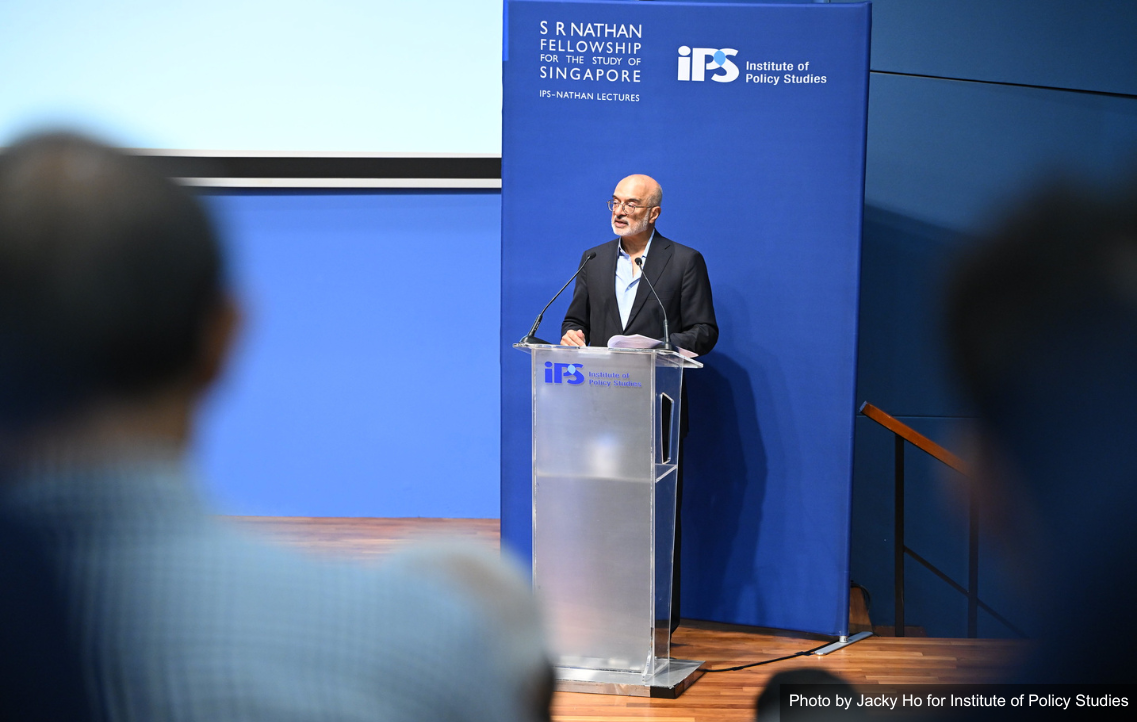
In his final IPS-Nathan Lecture, Mr Piyush Gupta, former Chief Executive Officer and Director of DBS Group, turned his attention to Singapore’s financial future. He argued that a new wave of change is underway, driven by blockchain, which has given rise to new financial infrastructures and new forms of digital money, and agentic artificial intelligence (AI). The central question, he suggested, is whether Singapore will merely adapt at the margins or make a deliberate leap towards a new financial order while preserving its longstanding strengths of stability and trust.
New forms of value and transactions
He began by revisiting the nature and functions of money. Money, he noted, has no intrinsic value. It is a social construct that derives its worth from collective trust in its role as a medium of exchange, unit of account and store of value. In today’s two-tier system, most money is “fiat” money, where liabilities of central banks and commercial banks rest on confidence in states, institutions and regulation. The current model, however, has weaknesses. Domestic trust can erode when governments lose credibility, and cross-border payments remain slow, opaque and costly because national currencies must move through a chain of correspondent banks.
He continued by explaining how blockchain and distributed ledger technology offer an alternative way to build trust. By recording transactions on a shared ledger where each block is cryptographically linked to the previous one, blockchain makes tampering difficult and allows all participants to see the same record. Blockchain technologies enable several properties. First, tokens can be exchanged in real time, eliminating settlement risk. Second, smart contracts that execute transactions automatically when conditions are met. Finally, fractionalisation of assets, which can widen access to traditionally illiquid, high-value assets. In cross-border payments, for instance, tokenised funds can be sent directly to end-recipients almost instantly, as demonstrated by platforms such as Partior, a blockchain-based network for real-time cross-border money transfers set up by DBS, JP Morgan and Temasek.
Types of digital currencies
Mr Gupta outlined four main types of digital currencies emerging from this technological base. Central bank digital currencies (CBDCs) — both retail and wholesale — are public digital money issued by central banks. He highlighted that about 91 per cent of central banks are exploring CBDCs, with the Bank for International Settlements (BIS) projecting that around two dozen could have CBDCs in circulation by 2030. Retail CBDCs can promote inclusion and payment efficiency, while wholesale CBDCs are being tested to improve cross-border settlement.
Tokenised deposits, by contrast, are commercial bank liabilities converted into transferable tokens. Banks such as DBS, JP Morgan and HSBC have already launched such solutions, which enable instant settlement and have the potential to offer programmable features like automatic interest payments and collateral management.
He then introduced privately issued cryptocurrencies and stablecoins. Cryptocurrencies such as Bitcoin and Ethereum now command a market capitalisation that recently exceeded US$4 trillion. However, he argued that they are unlikely to replace public money. These privately-issued cryptocurrencies may serve as speculative “stores of value”, but their volatility, limited acceptance and lack of a credible issuing authority make them poor units of account and mediums of exchange.
Stablecoins, by contrast, aim to maintain a stable value by being backed one-for-one by fiat assets or governed by algorithms. Today, US dollar-denominated stablecoins account for about 99 per cent of the global stablecoin market and are increasingly used for payments, especially in emerging markets with weaker currencies. However, their growth raises concerns. Mr Gupta highlighted risks of capital flight from emerging-market banking systems into US dollar proxies; estimates suggest up to US$1 trillion could move from emerging-market banks into stablecoins over the next few years. At the same time, stablecoins have overtaken Bitcoin as the preferred vehicle in illicit finance. Recent regulations, such as the US GENIUS Act and the Monetary Authority of Singapore’s (MAS) own rules, requiring 100 per cent reserve backing for certain single-currency stablecoins, are attempts to harness their benefits while containing these risks.
Agentic AI
Beyond blockchain, Mr Gupta argued that agentic AI systems, which can act autonomously to complete end-to-end tasks, will further reshape finance. He pointed to emerging “agentic commerce” models, where AI agents can search for products, compare options, execute payments and arrange delivery with minimal human input. Partnerships such as OpenAI’s collaboration with Stripe and services like Amazon’s “Buy for Me” illustrate how AI could eventually link directly into payment and settlement systems — changing not just how people transact but also who or what initiates those transactions.
Blockchain and tokenisation initiatives in Singapore
Having mapped these global shifts, he assessed Singapore’s response. MAS has, over the past decade, launched a series of pilots with industry partners to explore blockchain and tokenisation. Project Ubin tested the use of distributed ledgers for payments and securities settlement, contributing to the later development of the multi-currency Partior platform. Project Orchid focuses on developing the infrastructure for a digital Singapore dollar and “purpose-bound money”, with pilots ranging from programmable rewards in DBS PayLah! to conditional payments in construction projects and cross-border payment use cases involving Ant International, Grab and StraitsX. MAS has also announced Project BLOOM, a new initiative to support tokenised deposits and stablecoins for wholesale settlement, and Project Guardian, a multi-jurisdictional effort involving more than 40 financial institutions to trial asset tokenisation across foreign exchange, funds and fixed income products, alongside work on common standards and interoperable “Global Layer One” networks.
Tokenisation is also advancing through the private sector. Mr Gupta noted that banks have begun issuing tokenised structured notes and bespoke tokenised bonds to accredited investors, while global asset managers such as Franklin Templeton, UBS and Wellington Management have launched tokenised money-market funds in Singapore. In Singapore, regulated stablecoin issuers such as StraitsX and Paxos now back their Singapore dollar and US dollar stablecoins with reserves held at DBS and Standard Chartered, reflecting growing convergence between traditional finance and digital asset markets.
Mr Gupta argued that, despite these initiatives, Singapore remains largely in an experimental phase. MAS has been deliberately cautious about retail access to digital assets. At the same time, about a quarter of Singapore residents now hold digital assets, much of it outside the regulated sector, while other jurisdictions have started moving faster with legislation and bank–crypto linkages. Against this backdrop, he suggested Singapore faces a strategic choice between proceeding incrementally, or committing to building a new financial architecture anchored on AI and tokenisation. The country’s successful track record in payments with FAST, PayNow and SGQR, and the example of India’s Aadhaar system, show that bold public–private efforts can transform national infrastructure within a decade.
Shaping the future — potential paths for Singapore going forward
He outlined three domains where Singapore could take bolder steps.
First, in payments, he proposed that Singapore consider a digital Singapore dollar on a blockchain-based infrastructure. This can potentially serve as a retail CBDC or a well-regulated Singapore dollar stablecoin. Such a digital SGD could serve to simplify user experience and act as a buffer against potential outflows into US dollar stablecoins. More broadly, a digital SGD would signal Singapore’s intent to be at the forefront of the emerging tokenised world.
Second, he argued that tokenisation could be used to re-architect capital markets, where current processes remain costly and manual, with long settlement cycles and multiple intermediaries. Issuing and trading tokenised securities on distributed ledgers could reduce operating costs substantially while enabling near-instant settlement, improving capital efficiency and reducing counterparty risk.
Third, he highlighted the potential of tokenising real estate and other real-world assets. Today, property markets are illiquid and dependent on lengthy, paper-based processes involving multiple intermediaries. Recording property titles and transactions on blockchains could streamline due diligence and conveyancing, while smart contracts might automate mortgages and rental flows. Over time, tokenisation could underpin new markets, such as mortgage securitisation and fractional property investment.
Conclusion
He concluded by framing the choice ahead. Singapore, he argued, now has the resources, institutional experience and technological base to move first, rather than wait for full international alignment. Building a tokenised future will require interoperable infrastructure at scale, standardised asset tokens, safe settlement assets, institutional-grade networks and updated legal and regulatory frameworks for digital property and consumer protection. It will also require deep collaboration between public and private sectors, within and across borders.
But if any country can do this, he suggested, it is Singapore — a system that has repeatedly combined boldness, prudence and strong public–private partnership. Just as Britain once served as a launchpad for the Industrial Revolution, Singapore can position itself as a launchpad for a new global financial architecture, provided it continues to balance innovation with trust and stability.
Question-and-answer section
The question-and-answer segment, was moderated by Mr Caesar Sengupta, Co-founder and Chief Executive Officer of Arta Finance.
Mr Sengupta began by asking why Mr Gupta’s view on issuing a digitised Singapore dollar appeared to have shifted, given that the MAS has assessed there is no immediate need for a retail CBDC. Mr Gupta said he did not see a single “tipping point”, because fiat money would not disappear, but he now felt Singapore should still be prepared to issue a retail CBDC as part of building future financial infrastructure. He argued that the present payment landscape remains fragmented across multiple form factors, and he highlighted the strategic risk that, if stablecoins become mainstream, Singapore could face “capital flight” into US-dollar proxies unless it has credible domestic digital alternatives. He also acknowledged the risk that a retail CBDC could amplify bank runs if citizens could shift deposits directly into central-bank money, and suggested that design choices could mitigate those risks.
A follow-up question asked whether Singapore could realistically shape currency outcomes given the scale of the Singapore dollar. Mr Gupta responded that this would be difficult at a global level, but he pointed to how other countries have pursued deliberate strategies to increase usage of their currencies and payment rails, citing RMB internationalisation as an example and noting that its share in SWIFT transactions remains modest even as it has increased.
An audience member raised concerns about the energy costs of blockchain, particularly if tokenised systems scale to high-frequency transaction environments. Mr Gupta replied that data centres and compute remain a relatively small share of total global energy demand, and he suggested that data centres are also adopting both greener energy and more energy-efficient mechanisms. He added that the overall trade-off should also consider potential energy savings if AI-driven productivity reduces the amount of work required across the economy.
On closing loopholes to curb financial crime without stifling innovation, Mr Gupta argued that “zero crime” is not achievable, and that attempting to lock down the system completely would impose costs that would choke innovation. Instead, he advocated a balanced approach — a balance between reasonable preventive controls and due diligence, matched with stronger detection and response capabilities with advancements in AI technologies, so that bad actors can be identified and contained quickly. He also stressed the importance of credible consumer protection and compensation mechanisms for victims.
Responding to questions about the future of finance beyond blockchain, Mr Gupta pointed to agentic AI and its potential to automate end-to-end consumer journeys, raising the question of whether banks become “invisible” as finance is embedded into platforms. He explained that, even in an embedded-finance model, brand and trust could still matter; hidden infrastructure can retain value through reliability and reputation. He suggested that, rather than removing intermediaries altogether, new systems often create new forms of orchestration.
In the later questions, an audience member asked what Singapore’s banks might be getting wrong about AI adoption, and Mr Gupta said that many institutions still underestimate how profound the shift could be and therefore underinvest. He said AI required an “all in” commitment rather than incremental returns-based decision-making, and he emphasised that the most significant investment is in data.
Finally, questions addressed how quickly a new digital financial infrastructure could be built and adopted. Mr Gupta suggested starting with use cases that do not require immediate global consensus and highlighted the role of the public sector as a catalyst and convenor in getting ecosystems to move together. He also argued that technological adoption may occur in a parallel manner, especially in emerging markets where new consumer behaviours can scale rapidly.
Click here to watch the video of the lecture.