

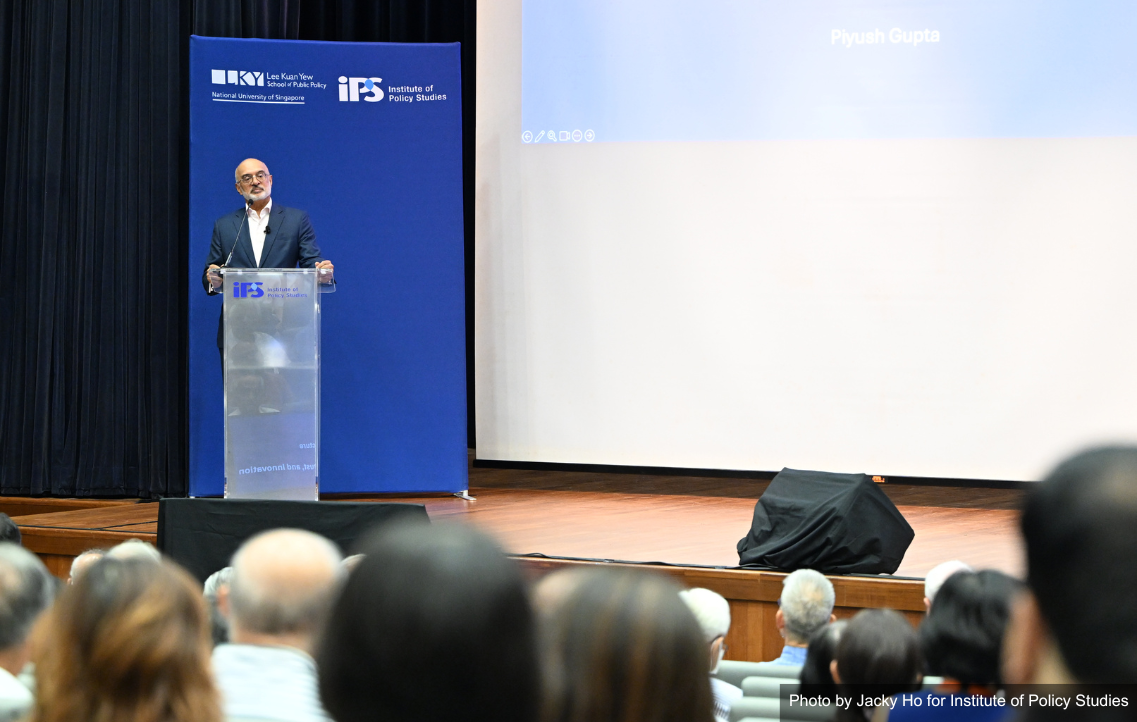
In his first lecture, Mr Piyush Gupta reflected on how Singapore, an “unlikely” financial centre without the large domestic engines typical of New York or London, transformed into a world-class hub by balancing stability, trust and innovation. He argued that this balancing act has been central to Singapore’s success and will become even more critical as finance undergoes another profound reinvention.
He began by emphasising the scale of Singapore’s financial sector. It now accounts for about 14 per cent of Singapore’s GDP, is home to more than 2,500 institutions, and employs over 200,000 workers. Beyond its domestic footprint, Singapore ranks among the top global financial centres and serves as Asia-Pacific’s largest foreign exchange (FX) hub. These are outcomes that, he stressed, arose from bold policy choices, nimble pivots and close public–private partnership rather than happenstance.
Tracing the history of Singapore’s financial sector
Mr Gupta traced Singapore’s financial sector’s origins to the creation of the Asian Dollar Market (ADM) in 1968. Catalysed by advice from Dr Albert Winsemius and banker Mr J. D. van Oenen, who saw Singapore’s potential to bridge American and European trading hours, policymakers recognised an opportunity to intermediate Euro-US dollar flows for a rapidly industrialising Asia and to complement the country’s export-oriented manufacturing base. This was not an obvious bet in a world that was only beginning to move beyond sterling’s post-war dominance, he noted.
A distinctive architecture followed. The Monetary Authority of Singapore established a two-tier banking system that separated international from domestic business via the Asian Currency Unit (ACU) and the Domestic Banking Unit (DBU). With concessionary tax on offshore income and lighter rules, deposits in ACUs grew more than 60 per cent annually through the 1970s, reaching US$9.5 billion by March 1981 across 120 ACUs. The structure both insulated domestic monetary policy and banks from offshore volatility and drew multinational treasuries to Singapore — a deliberate, unorthodox choice that contrasted with Hong Kong’s decision not to grow an offshore market.
Building Singapore’s markets
Market infrastructure reinforced the strategy. The launch of the Singapore International Monetary Exchange (SIMEX) in 1984, and its mutual-offset link with the Chicago Mercantile Exchange, enabled round-the-clock trading and pioneered Asian equity-index futures. During the 1987 crash, SIMEX’s decision to remain open provided much-needed price discovery. These moves underpinned Singapore’s ascent to become Asia’s largest, and the world’s third-largest, foreign-exchange centre.
After a prudentially conservative period in the 1980s and 90s that helped Singapore weather the Asian Financial Crisis, a comprehensive 1997 review set out three thrusts: liberalisation, supervisory reform and a more proactive development stance. Policy followed through in capital-market building by creating a credible Singapore Government Securities yield curve and in growing asset and wealth management through targeted incentives and anchor mandates. By 2024, assets under management in Singapore exceeded S$6 trillion, with most funds sourced from and invested outside Singapore, reflecting the city’s role as an international platform.
Balancing stability, trust and innovation
Across these phases, Mr Gupta underscored the repeated choice to take calculated risks within firm guardrails, choosing to remain nimble about innovation without eroding depositor confidence or macro-financial stability. That calibration, he suggested, remains Singapore’s comparative advantage as finance is reshaped by new technologies and market structures. The task is to keep marrying caution and creativity, as regulators, markets and firms have done at key junctures in the past.
Conclusion
Mr Gupta concluded that Singapore’s rise was neither linear nor accidental, but the product of boldness, disciplined execution and a habit of public–private collaboration. Sustaining that formula will be essential if Singapore is to anchor the next phase of financial change and continue to serve the region’s growth.
Question-and-Answer Session
The question-and-answer segment was moderated by Ms Teo Swee Lian, Chairman of CapitaLand Integrated Commercial Trust Management Pte Ltd.
Ms Teo observed that elements of Singapore’s model are being emulated elsewhere and asked how Singapore could stay ahead. Mr Gupta replied that Singapore’s edge lies less in any single rule and more in nimbleness: the ability to convene public, private and civic actors to move in concert, because the country is “big enough to matter” yet small enough to act quickly. Trust between regulator and industry, and a willingness to adapt to technology, give Singapore room to do things that some competitors cannot.
From the floor, a question on infrastructure finance was posed about why assets such as ports and airports have been harder to channel into capital markets. Mr Gupta replied that while it is already difficult for banks to use money they borrow in the short term to fund very long-term projects, the bigger obstacle is political risk: projects often outlast governments, and policy reversals unsettle investors. Strong guarantees against political risk, together with financing arrangements where public institutions take on more of the early risk to attract private investors, are therefore essential to crowd in private capital, especially as the transition to green infrastructure adds pricing complexities.
An audience member queried how Singapore could nurture a more growth-oriented investor base while safeguarding retail trust. Mr Gupta noted that Singapore’s high-trust “nanny state” sensibility has benefits but can dampen risk-taking; the right response is not to abandon protections, he said, but to strengthen investor education and, at the margin, tilt towards “buyer beware” so that responsible risk appetite can develop alongside market integrity.
On trust at home and in the neighbourhood, Mr Gupta observed that Singapore’s AAA standing confers a powerful halo on domestic institutions, but perceptions among regional neighbours can be more complex. He suggested that taking a longer view, for example through participation in nature-based or development projects where Singapore is willing to accept lower returns. That could deepen goodwill, because “we will succeed if the neighbourhood succeeds.”
In addressing a question on the state’s role in development. Mr Gupta described Singapore’s unique model, mixture of state ownership of capital through entities such as Temasek — coupled with professional, commercially-run management — as unusually effective. He argued that the priority today is to “crowd in” private entrepreneurship through enabling regulation (for example, licensing new categories of financial institutions) rather than to expand direct state enterprise.
Click here to watch the video of the lecture.